Story
Life & Career Journey
Rashid Hussain, Ph.D.
🇵🇰 Pakistan
🇬🇧 United Kingdom
🇮🇹 Italy
🇺🇸 United States (Remote)
🇪🇸 Spain
Scroll to explore
Every great scientific journey begins with curiosity. Mine started in Islamabad, Pakistan — where a fascination with biology, computation, and data drew me to study Bioinformatics at COMSATS University Islamabad.
Over four years of rigorous undergraduate study, I built the analytical and computational foundations that would underpin my entire career — covering bioinformatics, phylogenetic data analysis, and the quantitative tools that would define my scientific path.
The next chapter took me back to COMSATS University Islamabad — for an M.S. in Bioinformatics.
Immersed in a rigorous research environment, I advanced my understanding of sequence analysis, structural bioinformatics, and computer-aided drug design. My master's work laid the groundwork for a career defined by bridging biology, chemistry, and data science into a unified computational toolkit.
After my master's degree, my career took shape through both academia and industry. I began as a Research Intern at the National Centre of Bioinformatics, Quaid-e-Azam University — gaining hands-on research experience in a national bioinformatics hub.
My year as Research Associate & Teaching Assistant at LUMS was equally formative: I developed SPECTRUM, a MATLAB-based toolbox for top-down proteomics data analysis, while conducting HEC-funded HCV drug design research and teaching 28 undergraduate labs in Computational Biology and Protein Informatics — igniting a passion for science education that would grow throughout my career.
In parallel, I joined A.Z. Pharmaceutical Co. as a Research Assistant — contributing to pharmaceutical research and bridging my computational expertise with applied industry science.
I pursued my Ph.D. in Chemistry at Forman Christian College (A Chartered University), Lahore — graduating Magna Cum Laude (Higher Honors). My doctoral thesis, "Computer-Aided Drug Design and Synthesis of HCV NS3 Protease Inhibitors", tackled one of Pakistan's most pressing public health challenges.
The COVID-19 pandemic struck mid-doctorate. I pivoted rapidly to contribute — publishing a virtual screening study on piperidine-based SARS-CoV-2 inhibitors in 2020, demonstrating the power of computational chemistry to respond to emerging threats in real time.
During my doctoral years, I also created 19 YouTube tutorials on computational biology tools — reaching hundreds of early-career researchers across Pakistan who lacked access to formal training, and igniting a commitment to science education that would define the next chapter of my career.
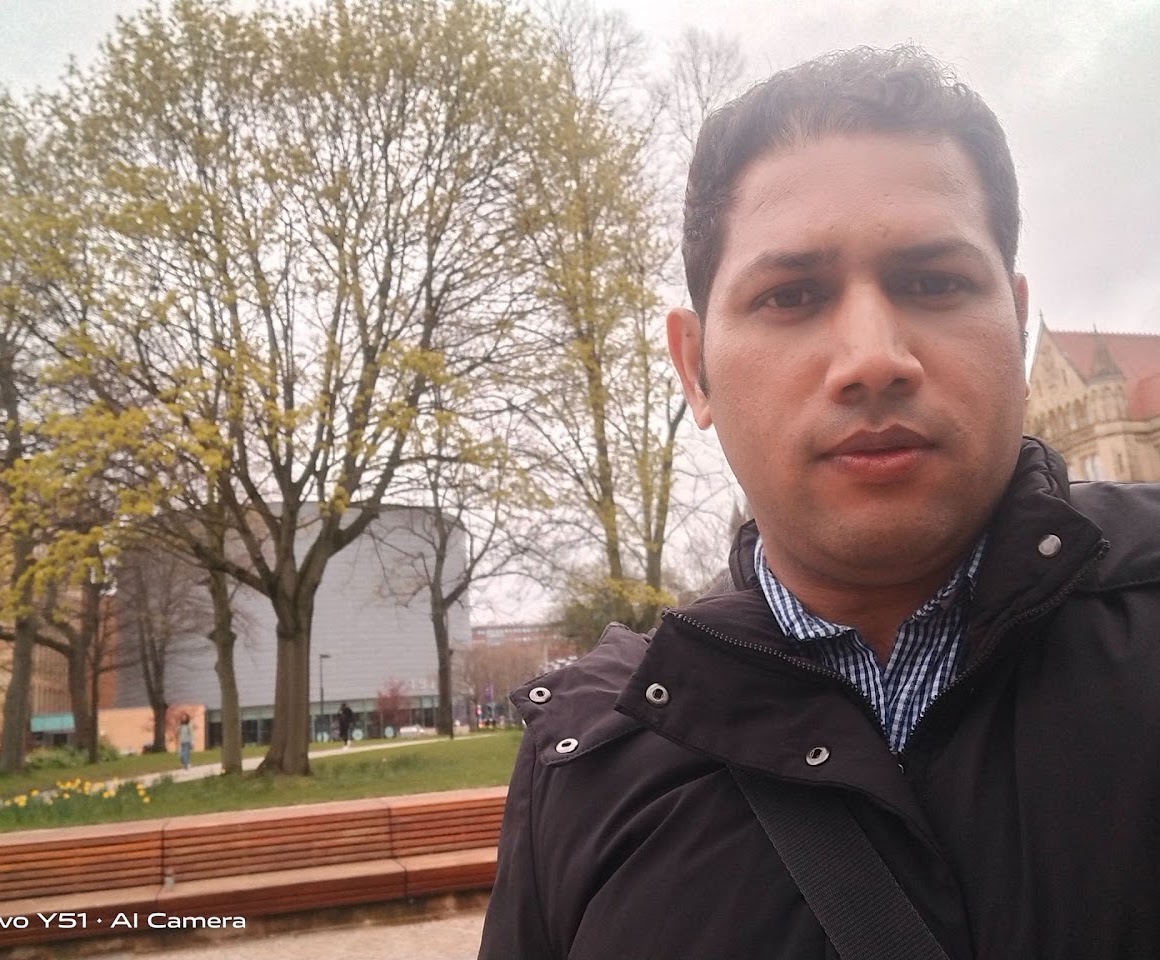
The breakthrough came in 2022. Awarded the prestigious IRSIP Fellowship (£6,250) by Pakistan's Higher Education Commission, I flew to Manchester to join Professor Lydia Tabernero's structural biology and drug discovery group at the University of Manchester — one of the world's leading research universities.
During six intensive on-site months, I developed VSpipe-GUI — a cross-platform, Python-based graphical interface for high-throughput virtual screening of large chemical libraries. The software became a cornerstone publication (IJMS, 2024) and the foundation of an ongoing international collaboration.
Manchester didn't just advance my research — it marked the beginning of a genuinely international career. By October 2022, I was also a Certified Carpentries Instructor, ready to take my teaching global.
Manchester opened the door and I walked through it. Over the next three years, I built a portfolio of international collaborations spanning continents — all while securing a Royal Society, UK–endorsed UK Global Talent Visa that recognised me as a leader in my field.
As a contract Software Developer for Deep Waters in New York, I built a PyMOL plugin for analysing water thermodynamics using Grid Inhomogeneous Solvation Theory (GIST). As a Bioinformatician at Ayass BioScience (Texas), I developed API-driven pipelines, transcriptome analysis workflows, and integrated agentic AI into biomedical data processing.
Throughout this period, my Carpentries teaching took me across three continents — Spain, the USA, and Bangladesh — making me a truly global science educator alongside my research career.
In January 2026, I joined Humanitas Research Hospital (IRCCS) in Rozzano, Milan — one of Italy's leading clinical research hospitals and a global hub for cancer science — as Postdoctoral Researcher in Computational Pathology.
My work centres on the SMS (Sarcoma Microenvironment Score) project: an AI-driven predictive and prognostic tool for sarcoma outcomes. Using Imaging Mass Cytometry (IMC) and multiplexed spatial omics data, I map the tumour microenvironment to extract spatially resolved biomarkers that go beyond conventional histology.
Simultaneously, I maintain my Visiting Academic role at the University of Manchester, contributing to drug discovery and fungal resistance research with Professor Lydia Tabernero's group — keeping one foot in drug discovery while the other advances cancer diagnostics.
In July 2026, I presented at the RSC Chemical Biology Symposium in London — the latest milestone in a career that shows no signs of slowing down.
Verified professional registrations, awards, and certifications from LinkedIn
Highlights from 2025–2026 — conferences, awards, and achievements
From the bioinformatics labs of Islamabad to the frontier of AI-driven cancer research in Milan — every chapter of my journey has been driven by one constant: the belief that computation can decode biology and improve human health. My next chapter is still being written.